

COMMERCIAL REAL ESTATE CASE STUDY
Establishing a reliable waste data baseline
WATS worked with a real estate owner and developer with over 70 million ft² of office space across 158 sites in the US and Canada.
Waste management and sustainability are important to them, and they have been working to improve the accuracy and management of their waste data.
13%
Increase in waste data confidence
Business Type
Commercial real estate
Business Details
70M+ ft² of office space
Needed a diversion baseline before taking action toward sustainability goals
Hindered by poor data quality
25 waste meter types
Challenge
The client wanted to set a baseline for portfolio-wide waste diversion but lacked trustworthy data:
Commercial: Invoices showed inflated diversion rates (up to 95%) that didn’t change each month or reflect reality. The team wanted comparative data points to hold vendors accountable.
Residential: NYC Department of Sanitation provides waste collection as a public service, so there are no invoices or reporting data to rely on.
In both cases, the client needed to gather their own data to establish a meaningful baseline and measure progress.
Solution
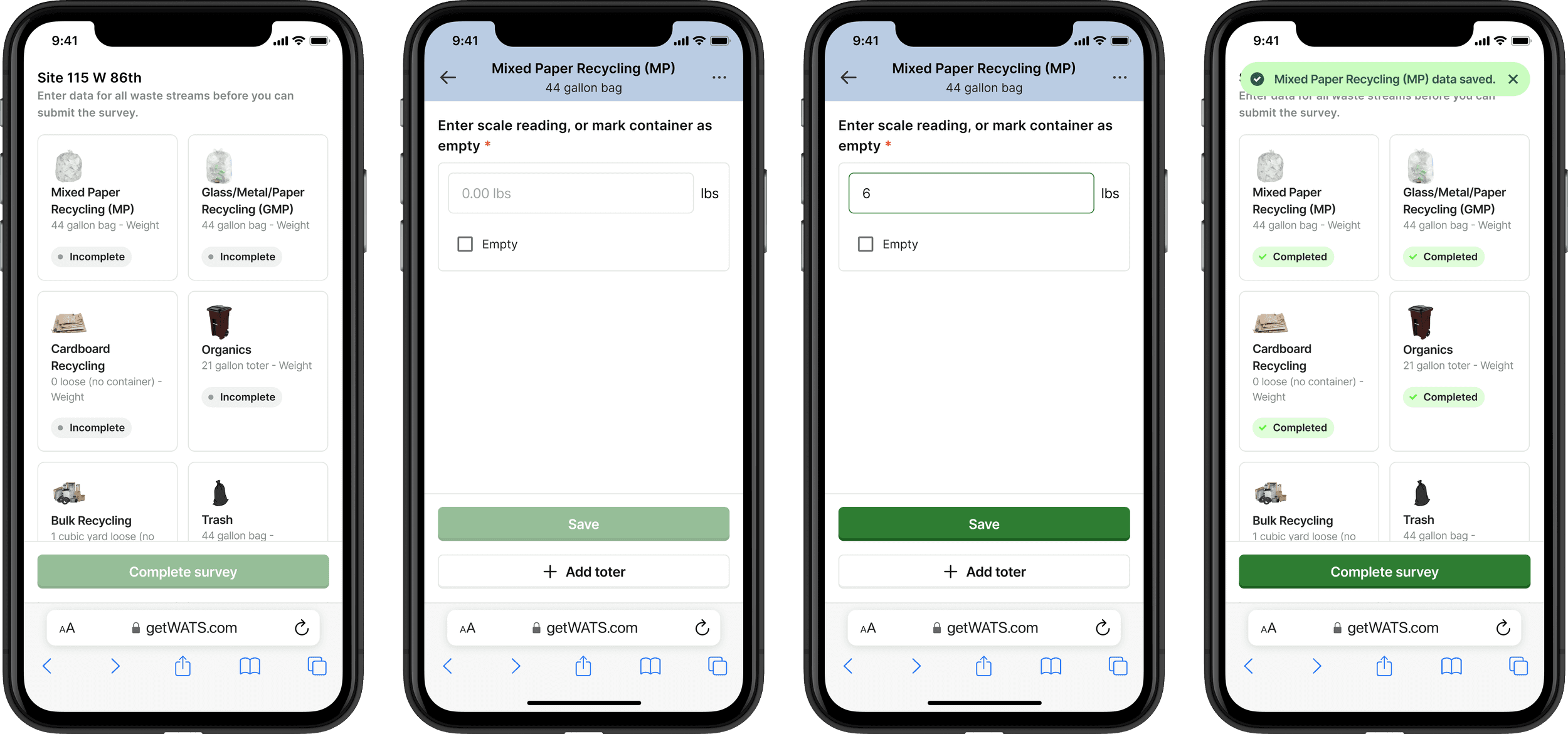
The client deployed WATS Surveys, a mobile-friendly feature designed to collect site-level waste data. Surveys capture weights, container counts, contamination observations, photos, and notes, creating a detailed picture of waste activity at each site.
Corporate stakeholders scheduled quarterly surveys across the portfolio.
Site staff received training through short mobile videos to complete surveys consistently.
Commercial: Surveys revealed that vendor invoices were overstating diversion and reported the same number each month. With this new baseline, the team now uses survey data as their source of truth and plans to require better vendor reporting in their next RFP.
Residential: Surveys established baseline diversion rates and tracked changes over time. They were especially valuable in measuring participation in NYC’s new organics mandate, highlighting where tenants were adopting the program and where support was still needed.
Results
Commercial: Proved invoice-reported diversion rates were unreliable, and replaced them with accurate, survey-based metrics. Surveys now drive vendor accountability and contract strategy.
Residential: Established a baseline diversion rate across all properties, tracked changes in tenant behavior, and measured organics program participation as the mandate rolled out.
Portfolio-wide: Ongoing surveys provide consistent, trustworthy data, enabling more strategic resource allocation and future program planning.
